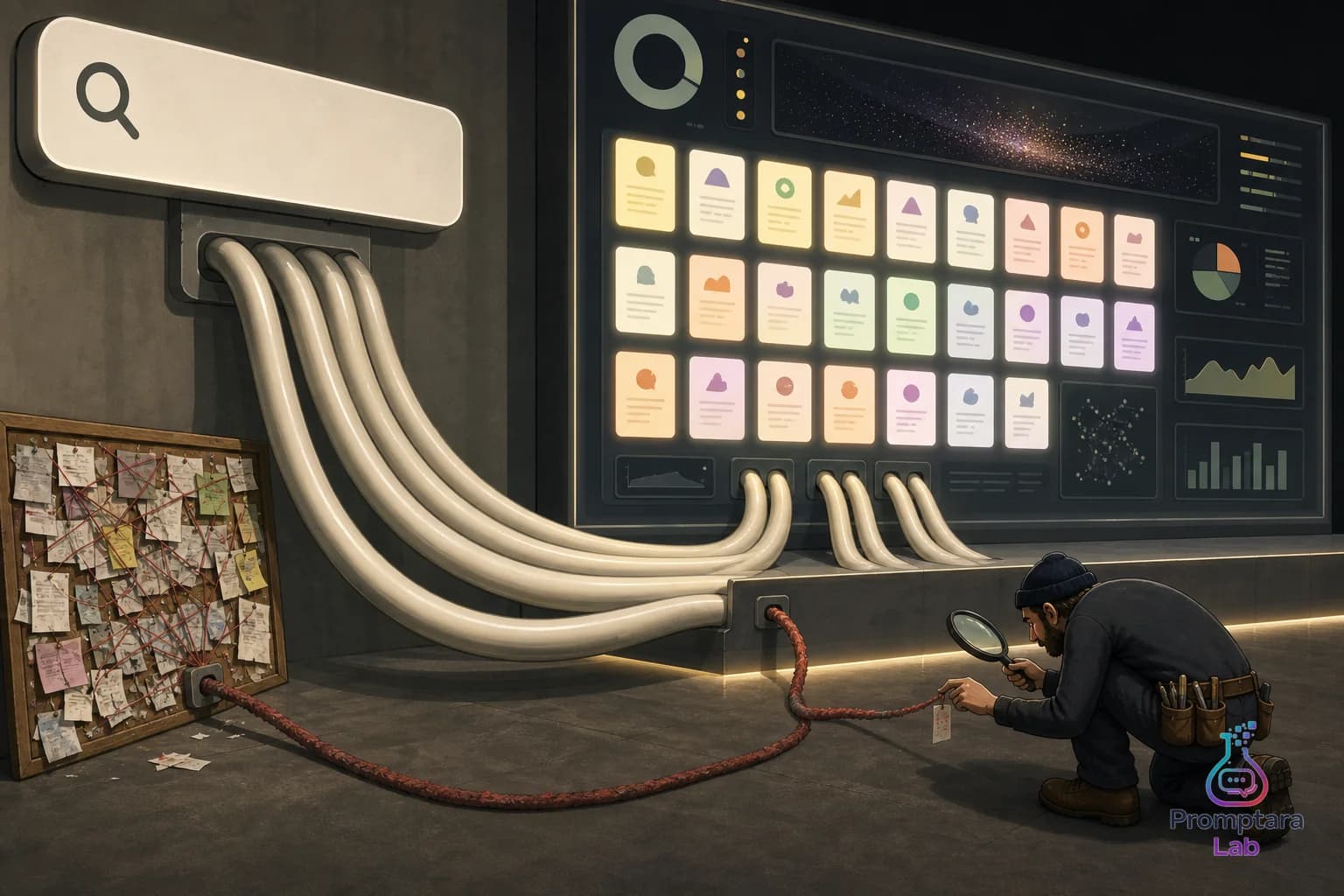
One Signal Needs a Holding Pen

One signal is an annoying little object.
It is too real to ignore. It is too thin to obey. It has just enough shape to tempt a builder into narrative, which is how a small product system ends up treating one action like a strategic memo from the market.
Promptara Lab keeps building around a less glamorous idea: a single signal needs a holding pen. Not a victory lap. Not a discard pile. Not a roadmap ticket wearing a fake mustache. A holding pen.
That sounds bureaucratic until the system starts seeing more than a person can responsibly interpret. Traffic arrives without actions. One surface records a small action. Signal systems produce observations, accepted rows, and opportunity candidates. A usage meter says the machines were cheap enough to keep running. The whole thing looks orderly. The danger is not chaos. The danger is premature meaning.
A thin signal is not junk
Builders often make one of two mistakes with thin signals.
The first mistake is dismissal. One action? Too small. One message? Anecdote. One search? Noise. Toss it out and wait for a cleaner pattern.
That sounds disciplined, but it can be lazy. Sparse behavior is still behavior. In small products, especially early or narrow ones, the first useful signals rarely arrive as a statistically satisfying marching band. They arrive as one odd query, one completion, one form submission, one user doing the thing while everyone else politely wanders around.
The second mistake is coronation. One action appears and suddenly the system has a new priority. Rewrite the page. Build the feature. Shift the content calendar. Change the offer. Alert the village.
That is not responsiveness. That is letting a tiny data point drive the forklift.
A traffic snapshot can show the shape cleanly: many surfaces get visits without actions, while one surface records one action from ten visitors. That one action deserves attention. It does not deserve the keys.
This is where a holding pen earns its keep.
Give the signal a room, not a throne
A holding pen is a product state for evidence that is real but not yet decisive.
It says: this happened, it is worth preserving, and no, we are not turning it into work yet.
That middle state is harder than it sounds. Most operating systems are better at binaries. New or old. Open or closed. Draft or published. Accepted or rejected. Useful product judgment often lives between those pairs.
A single action should carry its context into the holding pen. What surface did it happen on? What kind of action was it? Was there traffic around it? Was it paired with a signal observation, a search phrase, a content draft, or a support clue? Did similar behavior show up before, or is this the first weird little flare?
The point is not to make the holding pen ornate. The point is to keep thin evidence from being flattened into a slogan.
Promptara Lab has written before that ratios are questions, not grades. The same rule applies here. One action from a small visitor count is not a conversion verdict. It is a question with a timestamp, a surface, and a smell.
The holding pen preserves the question long enough for it to become useful.
The cheap machine makes this problem worse
Automation lowers the cost of noticing things. That is useful. It is also how operators drown in polite evidence.
An agentic framework under the hood of Promptara Lab can inspect outside signals, count observations, record accepted items, and propose opportunity candidates. A publication engine can prepare draft records. A usage meter can report that the run was inexpensive enough to repeat. In one recent usage report, the prior day’s activity was 28 requests with a recorded cost of 1.924699.
That is not a scary number. It is also not permission to make every observed thing important.
Cheap sensing creates a new obligation: better triage. If the machine can afford to notice more, the product system has to get better at deciding what kind of attention each notice deserves.
A holding pen protects the operator from two bad defaults:
- Treating every candidate as work.
- Treating every thin signal as disposable until it becomes obvious.
Both are expensive in different costumes.
The first spends attention too early. The second throws away the breadcrumbs that later explain why a pattern was emerging. Neither is especially noble.
What belongs in the holding pen
The holding pen should accept signals that are real, small, and not yet actionable.
That includes a lone action on a lightly trafficked surface. It includes a repeated phrase that has not yet earned a content decision. It includes an opportunity candidate that sounds plausible but lacks enough supporting evidence. It includes a draft idea that is specific enough to keep but not urgent enough to schedule.
It should not accept vague vibes. “People might want this” is not evidence. “One person completed this action after landing on this surface” is evidence. Thin evidence, but evidence.
Good holding pen entries usually need only a few fields:
- the observed behavior
- the source or surface
- the rough surrounding context
- the next condition that would make it worth promoting
- the reason it is not being acted on yet
That last field is underrated. A system that cannot say why work is parked is just hiding decisions in softer language.
This connects directly to another Promptara Lab habit: an opportunity is not a work order. A candidate becomes work only after passing through judgment. The holding pen is where that judgment gets a place to stand.
Promotion should require a second piece of evidence
The simplest rule is also the least glamorous: one signal enters the holding pen, a second compatible signal can trigger review.
Compatible does not mean identical. A second signal might be another action, a repeated search phrase, a traffic pattern, a support question, or a draft that suddenly has better source material behind it. The system should not require perfect repetition. People are not that tidy.
But it should require something.
Without that requirement, the roadmap becomes an improv class. With it, the operator can let small evidence accumulate without pretending each piece is a command.
This is the tone Promptara Lab tries to keep across the portfolio: interested, not gullible. The public surface at Promptara Lab is built around that posture. The machine can notice. The system can preserve. The operator still has to decide.
A holding pen is not where signals go to die. It is where they wait until they have earned a more expensive verb.